How Does Umbilical Cord MSC Therapy Differ From Bone Marrow Stem Cells?
If you have been researching stem cell therapy, you have probably come across different sources: bone marrow, adipose (fat) tissue, and umbilical cord tissue. Understanding the clinical differences between them is not just academic — it directly determines what you can expect from a treatment.
The Core Difference: Source, Age, and Collection
| Feature | Bone Marrow MSCs | Adipose Tissue MSCs | Umbilical Cord MSCs |
| Source | Patient’s own hip/pelvis | Patient’s own fat tissue | Donated cord/placenta tissue |
| Type | Autologous | Autologous | Allogeneic (donor) |
| Collection | Invasive bone aspiration | Minor liposuction procedure | None — pre-processed |
| Cellular biological age | Patient’s age | Patient’s age | Neonatal — biologically young |
| Cell volume | Limited by yield | Moderate yield | High density, scalable |
| Consistency | Varies by patient | Varies by patient | Standardized and characterized |
| Prior quality control | Not possible | Not possible | Full testing before use |
Why Cellular Age Matters More Than Most Patients Think
When stem cells are harvested from the bone marrow of a 50-year-old patient, you are working with 50-year-old cells. Their proliferative capacity, signaling potency, and anti-inflammatory output have naturally declined over the decades — the same way every biological system does with age.
Umbilical cord-derived MSCs come from tissue collected after healthy, full-term births. They are among the most biologically vital cells available in clinical medicine. They are young, highly communicative, and expand well under controlled laboratory conditions.
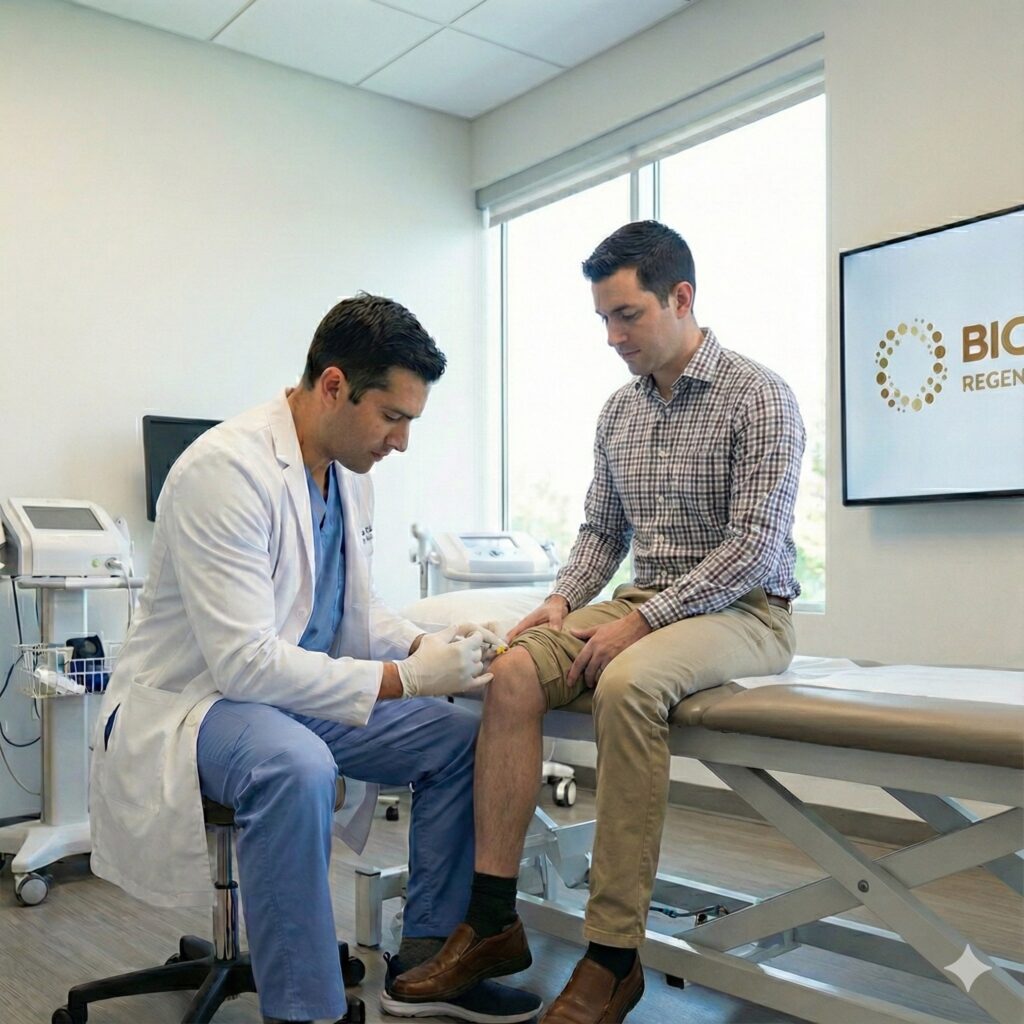
No Harvesting Procedure for the Patient
For patients already dealing with pain, limited mobility, or reduced recovery capacity, this is not a minor practical point. Bone marrow aspiration from the iliac crest is an invasive procedure with its own discomfort, recovery time, and risk profile. With umbilical cord MSCs, the patient experiences only the therapeutic application — no prior harvest, no additional sedation, no separate recovery period.
The Quality Control Advantage
Because cord cells are processed and stored in specialized laboratories, they can be thoroughly tested and characterized before they ever reach the patient. At Bioregenix, our MSC products undergo:
✓ Sterility verification
✓ Viability confirmation (percentage of live cells at the time of administration)
✓ Identity and phenotype testing
✓ Documented donor screening for transmissible diseases and genetic markers
✓ Contaminant screening
Why Bioregenix Uses Only Cord and Placenta MSCs
At Bioregenix, we made a deliberate, non-negotiable clinical decision: we do not use adipose or bone marrow stem cells in our protocols. Our treatment programs are built entirely around umbilical cord and placenta-derived MSCs, sourced from rigorously screened donations and processed under strict quality standards.
This is not a preference — it is our medical standard. For patients who travel to Guadalajara seeking truly advanced regenerative care, we offer the most biologically potent, least procedurally burdensome, and most consistently characterized therapy available in the field.
→ Learn more about the source of our MSCs and our protocols at Bioregenix
Dr. Habib Bechelani Kuri, MD | Regenerative Medicine & Human Optimization | Bioregenix, Guadalajara, Jalisco, Mexico