


Disc Repair Versus Fusion: Which Path Fits?
A lumbar disc problem can turn ordinary life into negotiation: whether you can sit through dinner, lift a grandchild, finish a workday, or walk without guarding every step. In the conversation around disc repair versus fusion, the central question is not simply which procedure is newer or less invasive. It is which approach best matches the source of pain, the stability of the spine, the condition of nearby joints, and the life you want to return to.
Fusion has a long and established role in spine surgery. Disc repair is a broader term that can describe motion-preserving surgery, biologic treatments intended to support disc health, or non-surgical care designed to reduce inflammation and improve function. Those differences matter. A meaningful decision starts with a precise diagnosis, not a one-size-fits-all promise.
What a Damaged Disc Can and Cannot Explain
Spinal discs are the flexible cushions between vertebrae. Their outer layer, the annulus, surrounds a gel-like center that helps absorb force and distribute load. With age, injury, repetitive strain, genetics, smoking, or reduced tissue hydration, a disc can lose height and resilience. A bulge or herniation may irritate a nerve root, producing sciatica, numbness, tingling, or weakness.
But an MRI showing disc degeneration does not automatically prove the disc is causing symptoms. Many adults have age-related disc changes without disabling pain. Facet joints, spinal stenosis, hip dysfunction, muscle deconditioning, inflammatory conditions, and nerve sensitivity can all contribute to a similar symptom pattern.
That is why a high-quality spine evaluation considers more than imaging. A clinician should connect your symptoms, neurologic exam, movement limitations, medical history, and imaging findings before recommending a treatment direction.
Disc Repair Versus Fusion: The Core Difference
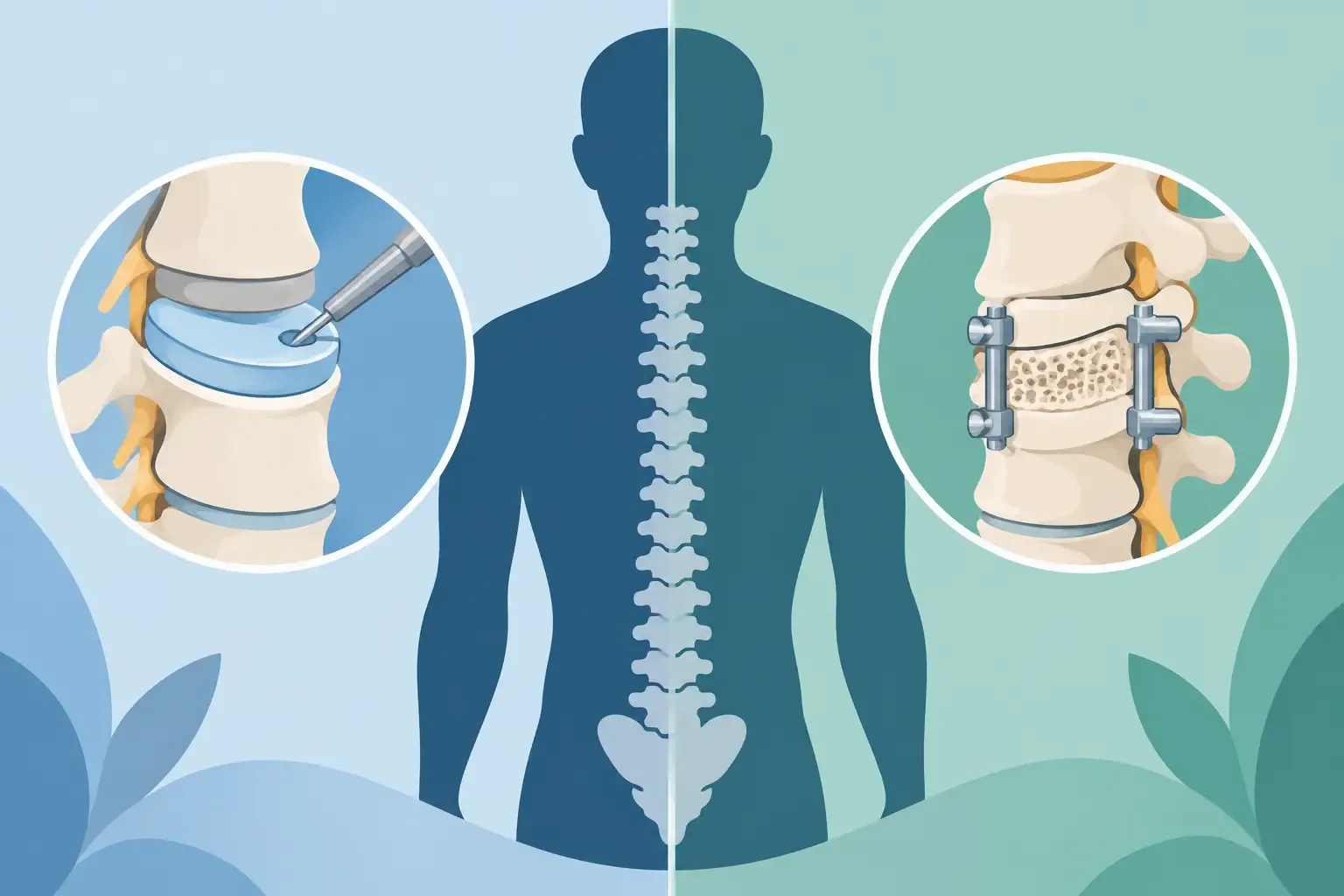
Spinal fusion intentionally joins two or more vertebrae so they no longer move independently. A surgeon may remove the damaged disc, place a spacer or bone graft material in the disc space, and secure the segment with hardware. The goal is stability. By reducing motion at a painful or unstable level, fusion can relieve mechanical pain, correct deformity, protect nerves, and support spinal alignment.
Disc repair aims to preserve or improve the natural disc environment rather than eliminate motion at that spinal level. Depending on the diagnosis, this may involve conservative rehabilitation, targeted injections, investigational biologic approaches, surgical repair techniques in select cases, or artificial disc replacement. These are not interchangeable treatments, and not every approach is appropriate for every disc problem.
Artificial disc replacement is often confused with disc repair. It is a surgical procedure that removes the diseased disc and replaces it with a motion-preserving implant. It may be considered for carefully selected patients, most commonly in the cervical spine and in certain lumbar cases. It is not the same as regenerating a native disc.
When Fusion May Be the Stronger Option
Fusion can be a highly appropriate and life-changing treatment when the spine needs structural stabilization. It is often considered when there is significant instability, such as spondylolisthesis; severe disc collapse; deformity; recurrent disc herniation with loss of stability; fracture; infection; tumor; or nerve compression that requires extensive removal of stabilizing tissue.
For some patients, the trade-off is clear: less motion at one segment may be worth the chance to reduce severe pain, prevent neurologic decline, or restore the ability to stand and walk. Modern fusion techniques have improved, but fusion remains major surgery. Recovery can involve activity restrictions, physical therapy, and months of bone healing.
There are also risks to discuss openly. These include infection, blood clots, hardware complications, incomplete fusion, persistent pain, and the possibility that added stress on nearby spinal levels may contribute to future degeneration. A fusion should never be framed as a guaranteed cure, especially when pain has multiple drivers.
When a Motion-Preserving or Regenerative Strategy May Be Considered
Patients with early-to-moderate degeneration, preserved spinal alignment, no major instability, and symptoms that have not responded to standard conservative care may be candidates for a motion-preserving discussion. The exact options depend on whether the primary issue is a contained disc injury, nerve compression, inflammatory pain, mechanical instability, or widespread degeneration.
Non-surgical care often remains the starting point. A disciplined program may include physical therapy, core and hip strengthening, movement retraining, weight management when appropriate, anti-inflammatory strategies, and carefully selected pain procedures. These approaches do not rebuild a severely collapsed disc, but they can reduce stress on the spine and improve daily function.
Biologic medicine is an area of strong patient interest because it focuses on inflammation, signaling, tissue support, and the body’s capacity for cellular repair. Mesenchymal stem cells and other orthobiologic therapies are being studied for their potential role in modulating inflammation and supporting a healthier healing environment. Early research is promising in some settings, but results are variable, and biologic treatment is not a substitute for surgery when a patient has progressive weakness, bowel or bladder symptoms, severe instability, or urgent nerve compression.
In the United States, patients should also understand the regulatory landscape. Many stem cell-based interventions for disc disease are not FDA-approved specifically to regenerate spinal discs. A responsible clinic will explain what is known, what remains under investigation, expected goals, potential risks, and whether a treatment is being offered within an appropriate medical and regulatory framework.
The Questions That Shape the Right Decision
The best choice is rarely made from an MRI report alone. Ask whether the affected segment is stable, whether symptoms are primarily nerve-related or mechanical, and whether conservative treatment has been thorough enough to judge. If surgery is recommended, ask what problem the operation is designed to solve and what symptoms may remain afterward.
It also helps to discuss the condition of adjacent levels. A single painful disc in an otherwise healthy spine is a very different situation from multi-level degeneration, osteoporosis, scoliosis, advanced facet arthritis, or a history of prior spine surgery. These variables can affect whether motion preservation is realistic and whether fusion is likely to deliver a durable result.
Your personal goals matter as well. Someone hoping to return to golf, travel, strength training, or active time with grandchildren may prioritize mobility and conditioning. Someone with progressive neurologic deficits may reasonably prioritize stabilization and nerve protection. Neither priority is wrong. The decision should reflect both the biology of the spine and the demands of the person living in it.
Building a Personalized Spine Plan
A modern spine plan does not have to begin and end with “live with it” or “schedule surgery.” For many people, there is valuable space between those extremes for diagnostic clarity, targeted rehabilitation, inflammation management, metabolic support, and carefully supervised regenerative strategies.
At BIOREGENIX, individualized care plans can incorporate advanced cellular therapies alongside supportive modalities such as IV therapy, hyperbaric oxygen, red light therapy, pulsed electromagnetic field therapy, and hormone optimization when clinically appropriate. These therapies are designed to support systemic health factors such as tissue oxygenation, inflammation balance, energy production, and recovery capacity. They should complement, not replace, surgical evaluation when structural spinal disease requires it.
The strongest care teams coordinate rather than compete. A spine surgeon, pain specialist, physical therapist, and regenerative medicine clinician may each bring a different but useful perspective. Seeking a second opinion is particularly reasonable before an irreversible procedure, and it is equally wise to obtain surgical input before pursuing a non-surgical program for serious spine symptoms.
Red Flags That Need Prompt Medical Attention
No discussion of disc treatment is complete without recognizing urgent warning signs. New or worsening leg weakness, loss of bowel or bladder control, numbness in the groin or saddle region, fever with severe back pain, unexplained weight loss, pain after significant trauma, or a history of cancer with new severe spine pain requires prompt medical assessment. These symptoms may point to conditions that should not be managed through routine conservative or regenerative care alone.
The most empowering next step is not choosing a camp in the disc repair versus fusion debate. It is getting clear on what your spine needs now, what can be protected, and what path gives you the best chance to move through life with greater confidence and less pain.