


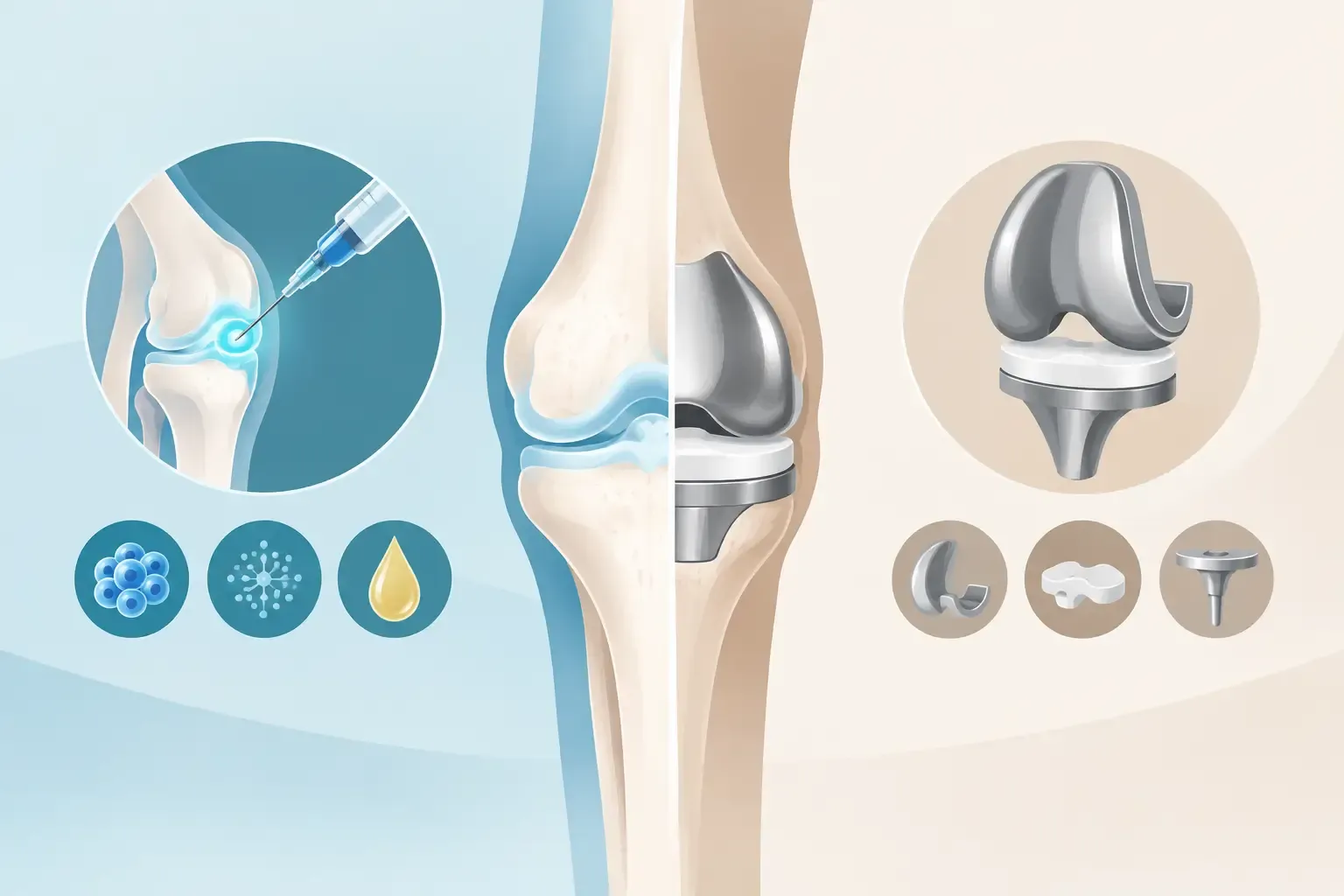
Orthobiologics Versus Replacement for Joint Pain
A knee that swells after a grocery run, a shoulder that wakes you at night, or a hip that makes stairs feel calculated can bring patients to the same crossroads: orthobiologics versus replacement. The right path is not simply the newest treatment versus the traditional one. It is a clinical decision shaped by your diagnosis, imaging, function, health history, goals, and the amount of healthy joint structure that remains.
For some people, joint replacement can be life-changing. For others, a personalized regenerative strategy may help reduce inflammation, support tissue health, improve mobility, and potentially delay or avoid surgery. The value is in knowing which conversation your joint actually calls for.
Orthobiologics Versus Replacement: The Core Difference
Joint replacement is a structural solution. In a knee, hip, or shoulder replacement, a surgeon removes damaged portions of the joint and replaces them with prosthetic components. It is designed for cases where pain and mechanical dysfunction are driven by advanced joint degeneration, deformity, bone-on-bone contact, or damage that can no longer be meaningfully managed with conservative care.
Orthobiologics are biologically derived treatments intended to influence the healing environment in a painful or injured area. Depending on the care plan, this category can include platelet-rich plasma, bone marrow-derived products, and cell-based therapies. These approaches aim to address inflammation, signaling, circulation, and the body’s repair response rather than replacing the joint itself.
That distinction matters. A biologic treatment cannot rebuild a severely collapsed joint into a brand-new joint, and a replacement does not restore the original biology of cartilage, tendons, ligaments, muscles, or systemic inflammation. Each option has a role, and neither should be sold as a universal answer.
When Replacement May Be the More Rational Choice
Replacement becomes more compelling when a joint has reached advanced structural failure. Persistent pain at rest, major loss of range of motion, progressive deformity, instability, and an inability to perform essential daily activities can all signal that surgery deserves serious consideration. X-rays and MRI findings matter, but they are only part of the picture. Some patients have dramatic imaging changes with manageable symptoms, while others have less striking scans and substantial disability.
A well-indicated replacement can provide reliable pain relief and a return to walking, sleeping, traveling, and participating in family life. It also has decades of surgical data behind it for appropriately selected patients. For someone whose quality of life has narrowed despite physical therapy, medication, injections, weight management, and activity modification, postponing surgery indefinitely may not be the best strategy.
Replacement also involves real trade-offs. Recovery requires commitment to rehabilitation, temporary limits on independence, and management of postoperative pain and swelling. Risks include infection, blood clots, stiffness, nerve or blood vessel injury, persistent pain, and, over time, wear or loosening of the implant. An artificial joint has a useful lifespan, which is especially relevant for younger, highly active patients who may need revision surgery later.
Where Orthobiologics Can Fit in a Joint-Care Plan
Orthobiologic care is often considered when a patient wants to preserve joint tissue, has mild to moderate degeneration, or is dealing with a tendon, ligament, muscle, or cartilage-related injury that has not fully responded to conventional treatment. It can also be an option for people who are not ready for surgery, cannot undergo surgery safely, or want to improve the biological conditions around a joint before making a surgical decision.
The goal is not to promise a shortcut. The goal is to create a more favorable environment for recovery. A carefully designed plan may seek to calm inflammatory signaling, support cellular communication, improve tissue oxygenation, and help a patient reengage in the movement that maintains strength and joint stability.
At BIOREGENIX, regenerative care is approached as more than a single injection or procedure. Personalized programs may integrate advanced cellular therapies with targeted IV support, hyperbaric oxygen therapy, red light therapy, pulsed electromagnetic field therapy, hormone optimization, and other modalities when clinically appropriate. The purpose of this coordinated approach is to support healing capacity at multiple levels, from inflammation and ATP production to circulation and recovery behavior.
Cell-based treatment deserves a clear-eyed discussion. In the United States, many regenerative and stem cell interventions marketed for orthopedic conditions have not been approved by the FDA, and evidence quality varies substantially by product, preparation method, diagnosis, and study design. Umbilical cord-derived mesenchymal stem cell therapies are an active area of research, but they should not be presented as a guaranteed cartilage-regrowth treatment or a replacement for surgery in every case. Patients should ask how a product is sourced, screened, processed, stored, administered, and monitored, as well as what evidence supports its proposed use.
Your Diagnosis Matters More Than the Label
“Arthritis” is not one diagnosis, and “joint pain” is not one problem. Pain may originate in cartilage wear, a meniscal tear, tendon degeneration, labral damage, spinal nerve irritation, autoimmune inflammation, muscle weakness, or a combination of factors. A patient with early knee osteoarthritis and a stable joint has different options than a patient with severe varus deformity, recurrent effusions, and bone-on-bone disease.
The same principle applies to hips and shoulders. A shoulder with tendon pathology may respond very differently than one with advanced glenohumeral arthritis. A hip pain complaint may be caused by joint degeneration, but it can also be referred from the lumbar spine. High-quality decision-making begins with an accurate diagnosis, appropriate imaging when needed, and an examination that connects scan findings to real-life function.
Questions That Clarify the Best Next Step
Before choosing orthobiologics or replacement, ask the specialist evaluating you what is causing the pain and whether the joint is structurally salvageable. Ask what outcome is realistic for your condition: less pain, improved walking tolerance, better range of motion, delayed surgery, or restoration of a specific activity.
You should also ask how the proposed treatment will be measured. Meaningful care has a follow-up plan. That may include changes in pain, sleep, strength, range of motion, medication use, walking distance, exercise tolerance, or validated function scores. If a treatment is expensive, elective, or not covered by insurance, the clinician should be direct about that as well.
For orthobiologic programs, ask whether the treatment is being recommended as part of a broader rehabilitation strategy. Biology works best when it is paired with the basics that many painful joints still need: intelligent loading, strength training, mobility work, sleep, nutrition, and management of metabolic or inflammatory drivers. For replacement, ask about the expected recovery timeline, implant longevity, rehabilitation requirements, complication rates, and what support you will need at home.
A Better Decision Is Often a Staged One
The choice does not always have to be final on day one. A patient with moderate degeneration may pursue a supervised regenerative and rehabilitation plan for a defined period, then reassess function and symptoms. If pain remains limiting and imaging confirms end-stage disease, replacement may still be available. Conversely, a patient told they need surgery may benefit from a second opinion if the diagnosis is unclear or conservative options have not been fully explored.
The most patient-centered approach resists two extremes: assuming every painful joint needs replacement and assuming every painful joint can be regenerated. Modern medicine is most useful when it matches the intervention to the biology, mechanics, and life goals of the person in front of it.
If you are weighing a procedure against a biologic approach, bring your imaging, prior treatment history, and the activities you want back to a qualified specialist. The most valuable next step is not choosing the most aggressive option. It is choosing a plan that gives your body, your joint, and your future mobility the most honest opportunity to improve.