Sciatica Relief Exercises for Better Daily Movement
A sharp, electric pain from the low back into the buttock, thigh, calf, or foot can change how you walk, sleep, drive, and play with your grandchildren. The right sciatica relief exercises are not about forcing a deep stretch through pain. They are about finding positions that calm an irritated nerve, restoring controlled movement, and building enough strength to help your spine tolerate everyday life again.
Sciatica is a symptom, not a diagnosis. It occurs when the sciatic nerve, or one of the nerve roots that forms it in the lower spine, becomes irritated or compressed. A disc bulge, spinal narrowing, degenerative changes, muscle tension, or inflammation can all contribute. That is why an exercise that helps one person may aggravate another. Your body’s response should guide the plan.
Start by Reading Your Symptoms
Before adding exercise, pay attention to where your symptoms travel. A useful sign is centralization: pain retreats from the calf or foot and becomes more localized to the buttock or low back. This can indicate that a movement is reducing nerve sensitivity, even if the back feels temporarily sore.
The opposite pattern deserves caution. Stop an exercise if pain moves farther down the leg, numbness increases, or weakness develops. Do not try to stretch through burning, tingling, or sharp radiating pain. The goal is calmer, more capable movement – not a bigger range of motion on day one.
Seek urgent medical care for new bowel or bladder changes, numbness in the groin or inner thighs, fever with severe back pain, significant leg weakness, or symptoms after major trauma. Persistent pain, progressive neurologic symptoms, or pain that repeatedly disrupts sleep also warrants a clinical evaluation.
Sciatica Relief Exercises to Try Gently
Perform these movements slowly on a stable surface. Start with one or two exercises that feel favorable rather than attempting every option in one session. For many people, five to 10 minutes once or twice daily is a more productive starting point than an intense workout.
1. Short, Frequent Walks
Walking is often underestimated because it is simple, but it can support circulation, reduce stiffness, and retrain a more natural gait. Begin with five minutes on flat ground at a relaxed pace. Keep your stride comfortable and avoid leaning heavily to one side.
If walking increases leg symptoms, shorten the distance or try several one- to two-minute walks throughout the day. Some people with spinal stenosis feel better with a slight forward lean, while others with disc-related symptoms may prefer a more upright posture. That difference matters.
2. Supported Prone Lying and Gentle Press-Ups
For some people whose symptoms worsen with prolonged sitting or bending forward, gentle extension may be useful. Lie on your stomach with a pillow under your hips or chest. Stay there for 30 to 60 seconds while breathing slowly. If this reduces or centralizes symptoms, progress to resting on your forearms.
A gentle press-up is the next option. Place your hands beneath your shoulders and press your upper body up while allowing your hips to stay relaxed against the floor. Keep the movement small and do not force the low back. Try five to 10 repetitions.
Stop if leg pain travels farther down the limb. Extension is not the right direction for everyone, particularly when standing and backward bending already provoke symptoms.
3. Supine Pelvic Tilts
Lie on your back with knees bent and feet flat. Exhale gently and flatten your low back toward the floor by lightly engaging your abdominal muscles. Then return to a neutral position rather than arching aggressively. Repeat eight to 12 times.
This small motion improves awareness of pelvic position and can reduce the guarding that often appears after a painful flare. Think of it as restoring control, not performing an abdominal workout.
4. Sciatic Nerve Glides
Nerve glides, sometimes called nerve flossing, use controlled motion to help the nervous system move more comfortably through surrounding tissues. They should feel mild. They are not hamstring stretches.
Sit tall on the edge of a chair. Slowly straighten the affected leg only as far as comfortable while lifting your chest and looking slightly upward. Then bend the knee as you gently lower your chin. Move back and forth without holding the end position. Complete five to 10 easy repetitions.
If tingling, burning, or pain lingers after the set, use less range or stop. A sensitized nerve generally responds better to gentle repetition than aggressive tension.
5. Figure-Four Hip Stretch, If It Feels Good
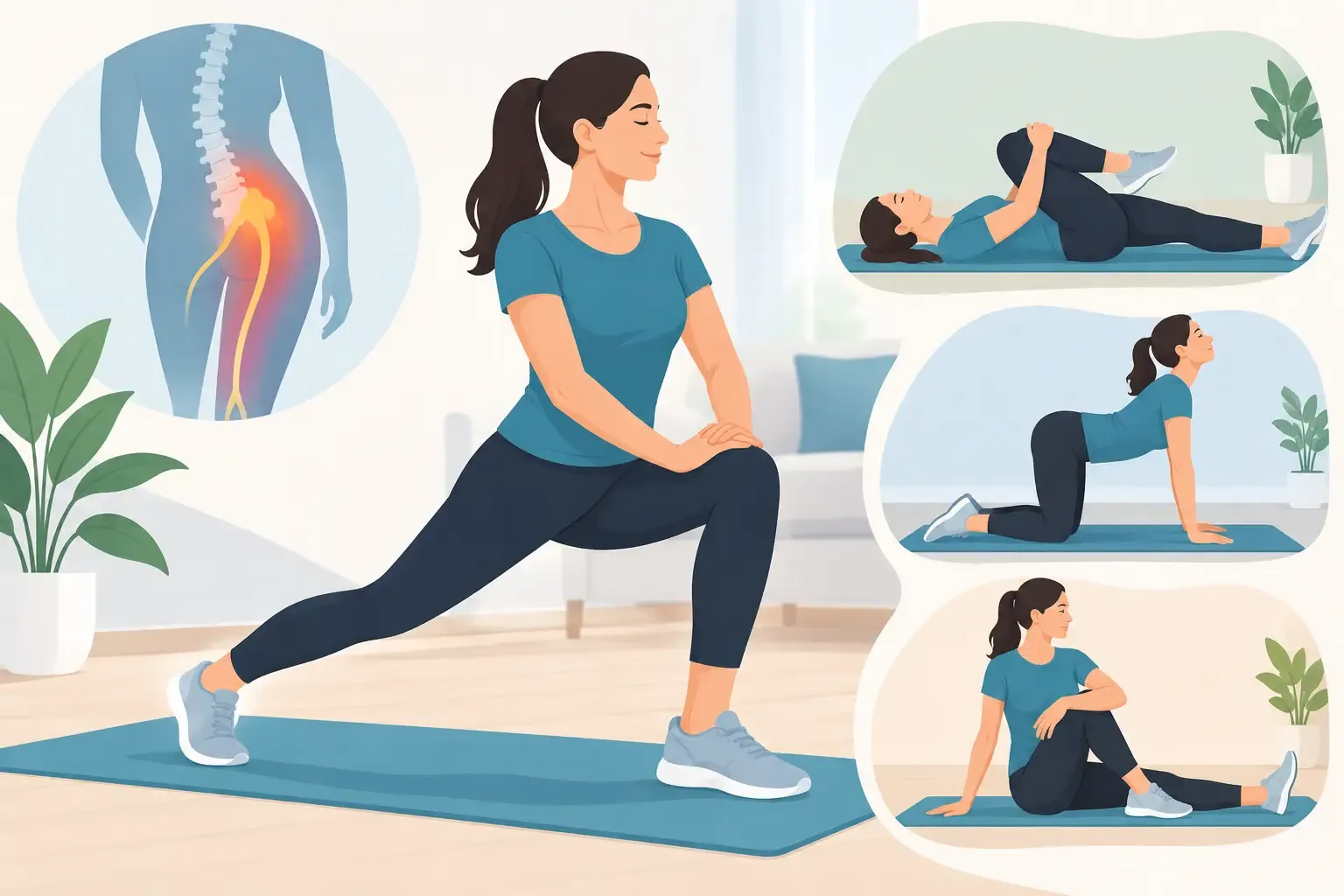
Tightness around the hips can change pelvic mechanics and contribute to discomfort, although it is not always the root cause of sciatica. Lie on your back and cross one ankle over the opposite thigh. If comfortable, draw the uncrossed leg toward you until you feel a moderate stretch in the buttock.
Hold for 15 to 20 seconds, then release. Repeat two or three times. Avoid this stretch if it recreates electrical pain down the leg. A buttock stretch can be helpful when muscular tension is involved, but it cannot correct every source of nerve irritation.
6. Bridge for Glute and Trunk Support
When acute symptoms have settled, bridges can strengthen the gluteal muscles and improve the support system around the pelvis. Lie on your back with knees bent. Lightly brace your abdomen, press through your heels, and lift your hips until your body forms a comfortable line from shoulders to knees.
Pause briefly, then lower with control. Start with six to eight repetitions. Keep the movement small if your back tightens, and stop if symptoms spread into the leg. Strength work should leave you feeling more stable, not inflamed.
Avoid the Common Mistake: Stretching Harder
Many people assume sciatica means a tight hamstring that needs forceful stretching. Sometimes the hamstring does feel tight, but that sensation may be the nerve protecting itself. Long-held toe touches, aggressive seated hamstring stretches, and deep twisting can aggravate a sensitive nerve root during a flare.
It is also wise to limit the positions that reliably trigger symptoms while you rebuild capacity. For some people, that means breaking up long periods of sitting. For others, it means avoiding extended standing, repeated lifting, or high-impact exercise for a period of time. Modification is not weakness. It is a practical way to lower irritation while the body recovers.
Use a simple response test: symptoms during exercise should remain mild, settle quickly, and not leave you worse later that day or the following morning. If they do, reduce the range, repetitions, or frequency. If one movement consistently helps, make it part of your daily routine before adding more.
When Exercise Is Not Enough
Exercise can be a meaningful part of conservative care, but it cannot always resolve the underlying driver of sciatica. Persistent disc-related pain, spinal degeneration, significant inflammation, structural narrowing, and progressive weakness may require a broader assessment. Imaging alone does not tell the entire story, but a specialist can correlate imaging findings with your symptoms, mobility, neurologic function, and treatment history.
A personalized plan may include targeted rehabilitation, anti-inflammatory strategies, treatment for contributing hip or spinal conditions, and regenerative approaches when clinically appropriate. At BIOREGENIX, individualized care plans are designed to look beyond temporary symptom suppression and assess the biological factors affecting tissue health, inflammation, mobility, and long-term function.
If your pain has made you avoid stairs, exercise, travel, or time on the floor with family, do not accept that shrinking routine as inevitable. Begin with calm, deliberate movement, watch how your symptoms respond, and seek individualized medical guidance when your body signals that it needs more than home exercise alone.