


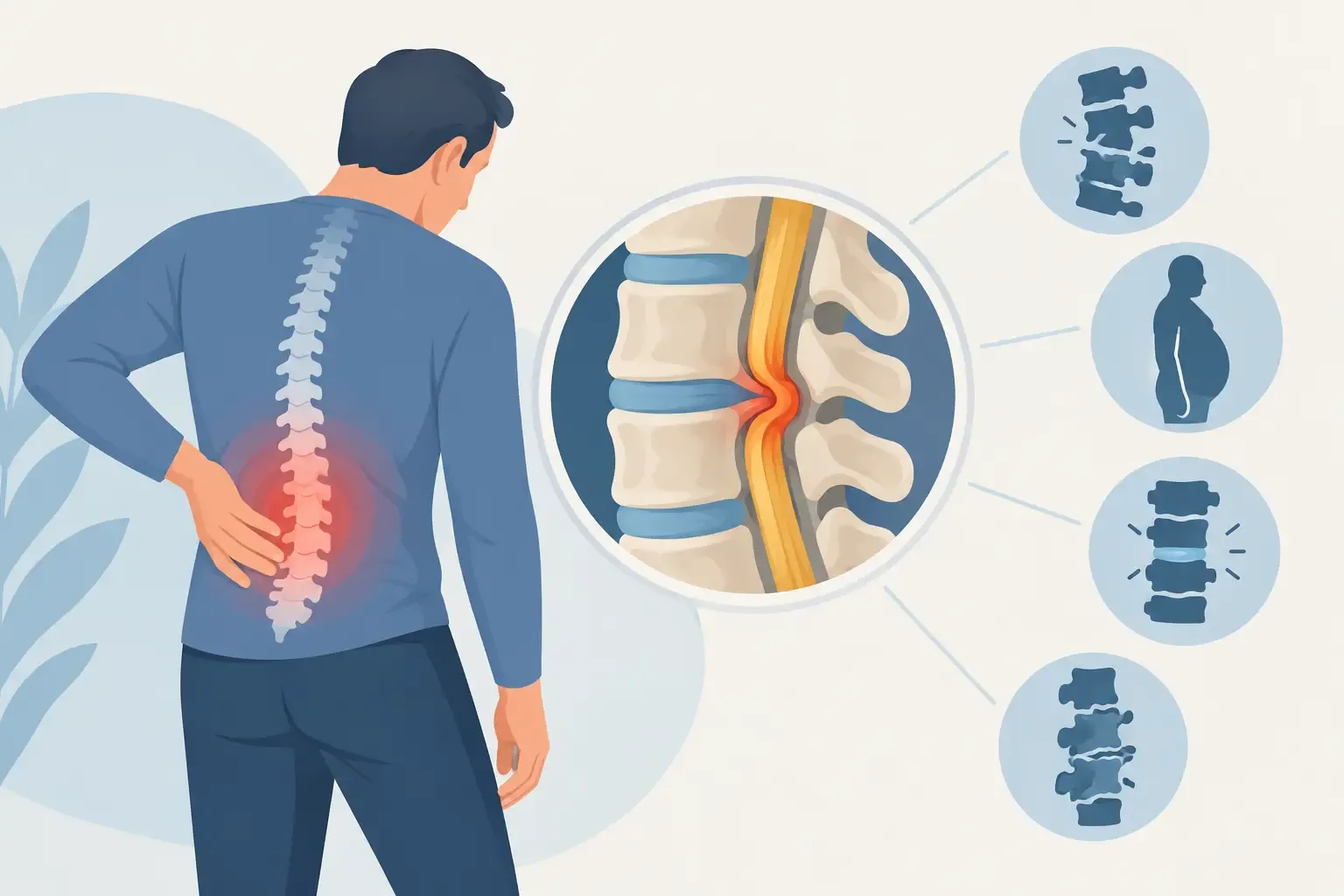
What Causes Spinal Stenosis? The Key Drivers
A person may notice spinal stenosis first as a change in routine: standing in a grocery line becomes painful, a walk requires frequent rests, or tingling travels down one leg. Understanding what causes spinal stenosis can replace uncertainty with a clearer path forward. In most adults, it is not one sudden event. It is the gradual narrowing of the spaces in the spine where the spinal cord and nerves travel.
That narrowing can create pressure on nerve tissue, leading to pain, numbness, weakness, balance changes, or reduced walking tolerance. The underlying cause matters because a narrowing driven by arthritis may be managed differently than one related to a disc herniation, prior surgery, or a naturally small spinal canal.
What Causes Spinal Stenosis in the First Place?
Spinal stenosis means that a passageway within the spine has become too narrow for the nerves it contains. It may affect the central canal, where the spinal cord or nerve bundle passes, or the smaller openings called foramina, where individual nerves exit the spine.
The condition is most common in the lumbar spine, or low back. Lumbar stenosis can cause sciatica-like leg pain, heaviness, numbness, or weakness that worsens with standing and walking. It can also occur in the cervical spine, or neck, where pressure on the spinal cord may affect the hands, arms, balance, and coordination.
A useful way to think about stenosis is as a space problem created by changes in several structures. Discs, joints, ligaments, and bone all share a limited amount of room around sensitive nerve tissue. When one or more of those structures enlarges, shifts, or loses healthy alignment, the available space can shrink.
Age-related disc changes
The discs between spinal bones act as cushions and help preserve the height of the spine. Over time, discs lose water content, elasticity, and height. A flattened disc can reduce the space between vertebrae and narrow the nerve exit openings.
A disc may also bulge outward or herniate through a weakened outer layer. This can take up space in the spinal canal, sometimes abruptly after lifting or twisting, although disc degeneration often develops gradually. Not every bulging disc causes symptoms. Symptoms depend on whether the disc contacts or inflames a nearby nerve and how much reserve space the canal has.
Arthritis and bone spur formation
Osteoarthritis is one of the most frequent contributors to spinal stenosis. As the facet joints in the spine experience years of load and motion, their protective cartilage can wear down. The body may respond by forming extra bone, commonly called bone spurs, around the joints.
These bony changes can extend into the spinal canal or foramina. Facet joint arthritis can also alter spinal mechanics, placing additional stress on discs and ligaments. This is why stenosis often reflects a chain of degenerative changes rather than a single damaged structure.
Thickened ligaments
Ligaments stabilize the spine, but they can become less flexible and thicker with age, chronic inflammation, or repetitive mechanical stress. One ligament in particular, the ligamentum flavum, runs along the inside of the spinal canal. When it thickens or buckles inward, it can reduce the room available for nerves.
This detail helps explain why imaging sometimes shows stenosis even when a disc bulge is small. The combined effect of disc height loss, arthritic joints, and ligament thickening can be substantial.
Other Causes of Spinal Canal Narrowing
Degenerative wear is common, but it is not the only explanation. Some people are born with a smaller-than-average spinal canal. They may have no symptoms for decades, then develop nerve compression when ordinary age-related disc or joint changes occur.
Spinal alignment conditions can also contribute. Spondylolisthesis occurs when one vertebra slips forward relative to the bone below it, narrowing the canal or nerve openings. Scoliosis, an abnormal side-to-side curve, can change how forces move through the spine and contribute to uneven narrowing.
Injury may play a role as well. A fracture, dislocation, or post-traumatic swelling can narrow spinal spaces. Previous spine surgery can occasionally lead to scar tissue or changes at nearby spinal levels. Less common causes include spinal tumors, cysts, certain metabolic bone conditions, and inflammatory diseases. These possibilities are one reason persistent neurological symptoms deserve a proper medical evaluation rather than assumptions based on a scan alone.
Why Symptoms Can Feel Worse Than an MRI Suggests
Imaging is valuable, but it is only part of the clinical picture. Many adults have disc degeneration or mild narrowing on MRI and feel little to no pain. Others have symptoms that significantly limit daily activity despite findings described as moderate.
Nerves respond not only to physical compression but also to inflammation, blood-flow changes, posture, movement, and the duration of irritation. In lumbar stenosis, standing upright may make symptoms worse because it further narrows the canal. Leaning slightly forward, sitting, or pushing a shopping cart may bring relief because those positions can create more space around the nerves.
Cervical stenosis requires especially thoughtful assessment. Pressure on the spinal cord can produce hand clumsiness, trouble with buttons or handwriting, gait instability, weakness, or changes in reflexes. These signs are different from ordinary neck soreness and should not be ignored.
Risk Factors That Can Accelerate Degenerative Changes
Aging is the strongest risk factor, but it does not mean loss of function is inevitable. Genetics influence disc structure, joint anatomy, and inflammatory tendencies. A history of repetitive heavy lifting, high-impact sports, smoking, obesity, sedentary behavior, and poorly managed metabolic health may contribute to faster degenerative change in some people.
At the same time, it is rarely useful to blame one behavior or one past injury. An active person can develop stenosis, and a sedentary person can have minimal narrowing. The goal is to identify the specific structures involved, the nerves affected, and the factors that can still be modified.
When Spinal Stenosis Needs Urgent Attention
New or progressive weakness, loss of hand coordination, major balance changes, numbness in the groin or saddle area, or loss of bladder or bowel control requires immediate medical attention. These symptoms can signal significant nerve or spinal cord compression.
For non-emergency symptoms, an evaluation typically includes a health history, neurological examination, and imaging when appropriate. X-rays can reveal alignment and instability, while MRI often provides a clearer view of discs, nerves, ligaments, and soft tissues. The best next step is based on symptoms and function, not imaging language alone.
A Personalized Approach to Managing Stenosis
Treatment depends on the location and severity of narrowing, whether weakness is present, overall health, and personal goals. Conservative care may include targeted physical therapy, movement modification, anti-inflammatory strategies, weight management when relevant, medication, and image-guided injections. Some patients with significant compression, progressive neurological decline, or persistent disability may need a surgical consultation.
Regenerative medicine may be considered within a broader, individualized plan for selected patients dealing with disc degeneration, joint inflammation, or chronic spine-related pain. It is critical to be precise about its role: cellular therapies do not mechanically widen a severely narrowed spinal canal or replace urgent surgical care when nerve function is at risk. Their potential value is being studied in relation to inflammation, tissue signaling, and the biological environment surrounding degenerative conditions.
At BIOREGENIX, personalized programs may combine physician-guided regenerative strategies with supportive approaches aimed at inflammation management, tissue oxygenation, mobility, and whole-body recovery. A responsible plan begins with diagnosis and candidacy, not a one-size-fits-all promise.
Spinal stenosis may be common, but the experience is deeply individual. If walking, sleeping, working, exercising, or playing with family has become harder, the next meaningful step is to understand what is narrowing the space around your nerves and address it with a care plan built around your function, safety, and long-term quality of life.